
Lists of the best agentic tools usually mix two different things: open-source projects that cost nothing and subscriptions that start free. This page keeps only the first kind. All eight picks are open-source projects from the LocalAIAgents dataset of 548 framework records, so the price of every entry is the same, zero, and the interesting column becomes the trade-off: the license, the language, the maintenance flag, the things the dataset records that a price tag usually hides. Star counts are as recorded at the September 14, 2026 snapshot.
The eight
1. LangChain (146,312 stars, Python, MIT). Best for: the ecosystem default. What recommends it: the widest integration surface in the dataset and a permissive license. The catch: the abstraction is deep enough that debugging your agent can mean debugging the framework too.
2. Dify (155,704 stars, TypeScript, custom terms). Best for: building visually without writing the app layer. The catch is in the license column: Dify's recorded license is custom terms rather than an OSI-approved open-source license, so it costs nothing to use and still asks to be read before you build a business on it. Its shelf is ranked in the open-source builders list.
3. Browser-Use (114,603 stars, Python, MIT). Best for: agents that work the web directly, clicking and typing where no API exists. The catch: browser agents inherit the web's fragility, and their running costs are model tokens, not licenses.
4. OpenHands (87,882 stars, TypeScript, MIT). Best for: autonomous coding work. The catch: the most capable free tools are also the ones that need the most supervision, and this one edits real code.
5. CrewAI (58,535 stars, Python, MIT). Best for: multi-agent crews with defined roles, the friendliest on-ramp in this list. The catch: role-play structures suit process work better than open-ended research.
6. Firecrawl (180,338 stars, TypeScript, AGPL-3.0). Best for: feeding agents clean web data, and the dataset's most-starred project overall. The catch is the strongest in this list: AGPL copyleft reaches network use, so a hosted product built on it owes source availability. Free is not the same as unconditional.
7. AutoGen (60,981 stars, Python, recorded license CC BY 4.0). Best for: research-grade multi-agent conversation. The catch is visible in its own record: the license is recorded as a Creative Commons content license, which is an odd instrument for software and worth verifying before commercial use, and its last recorded commit is April 2026 in a dataset whose active projects commit weekly.
8. Langflow (154,797 stars, Python, MIT). Best for: visual building with a code exit. The catch: Python-stack weight, and flows that outgrow the canvas end up as code anyway, which the maintainers would call a feature.
Which one is best?
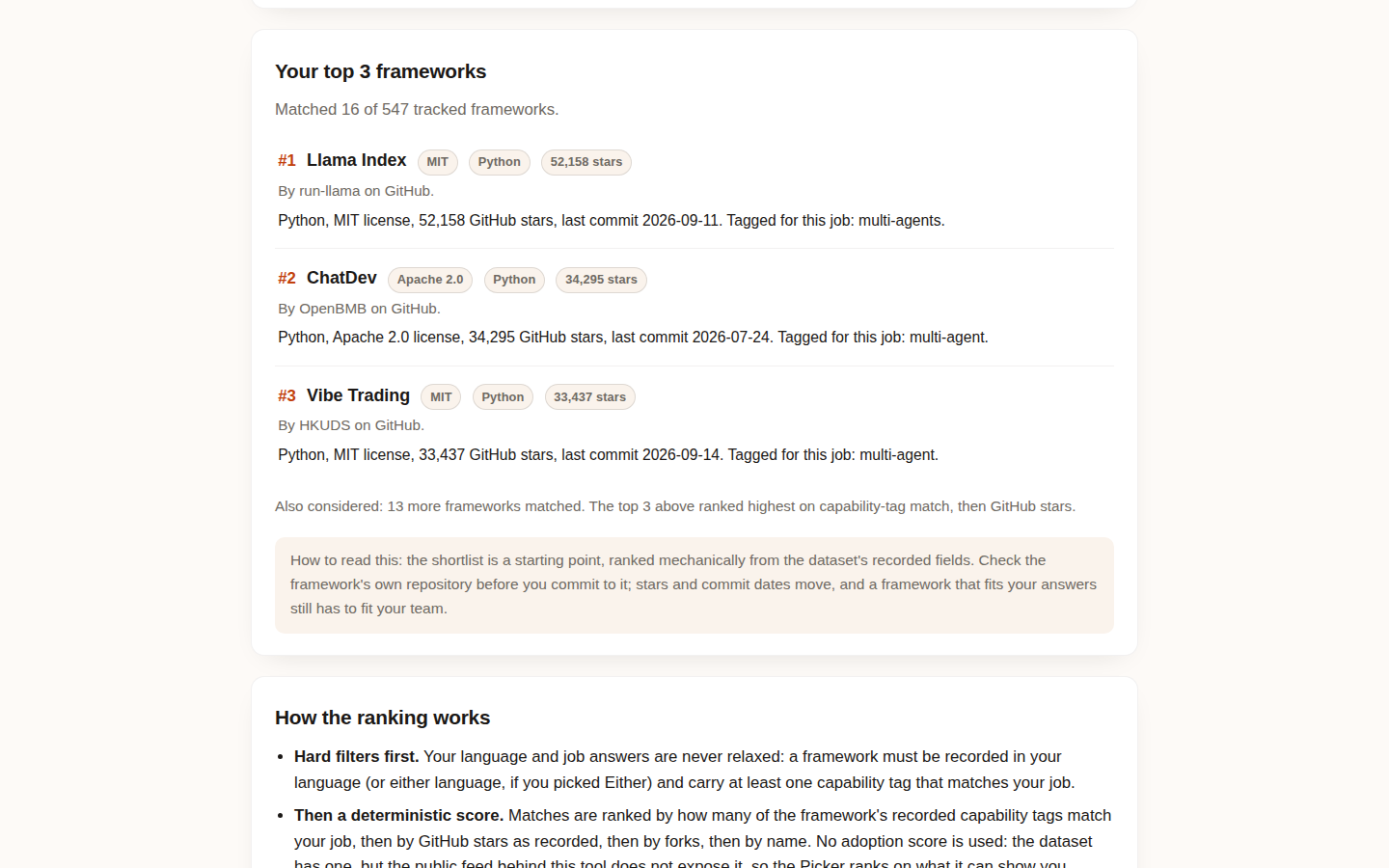
By audience, the way these lists should end. Non-technical builders: start with Dify or Langflow from the visual shelf. Developers who want the deepest ecosystem: LangChain, accepting the abstraction cost. Teams whose agents live on the web: Browser-Use for action, Firecrawl for reading, with the AGPL read first. Coding work: OpenHands, supervised. Multi-agent experiments: CrewAI for speed, AutoGen for depth. The full map, all 548 records with the same fields used here, is searchable on this site, and the FrameworkPicker turns four answers into a shortlist of three. The commercial comparison, including what the paid platforms add, is in free vs paid AI agent builder platforms, and the developer-stack view of this same dataset is in the stack guide.