
The question people type is which AI agent builder app iOS Android users should install. The honest answer starts one layer down. A builder app is a shell: it wraps a framework, and the framework's language decides what can run on the phone, what runs on a server, and what the phone can only watch. Our database holds 547 distinct frameworks, and their language split settles most of the iOS versus Android argument before it starts.
Python accounts for 274 of the 547 frameworks, exactly half the field. TypeScript holds 141 and JavaScript another 21, so 162 frameworks, about 30 percent, live in the JavaScript family. Rust contributes 24, Go 21, and the remaining 66 spread across everything else. That split, not the app store, is the real map of your options.
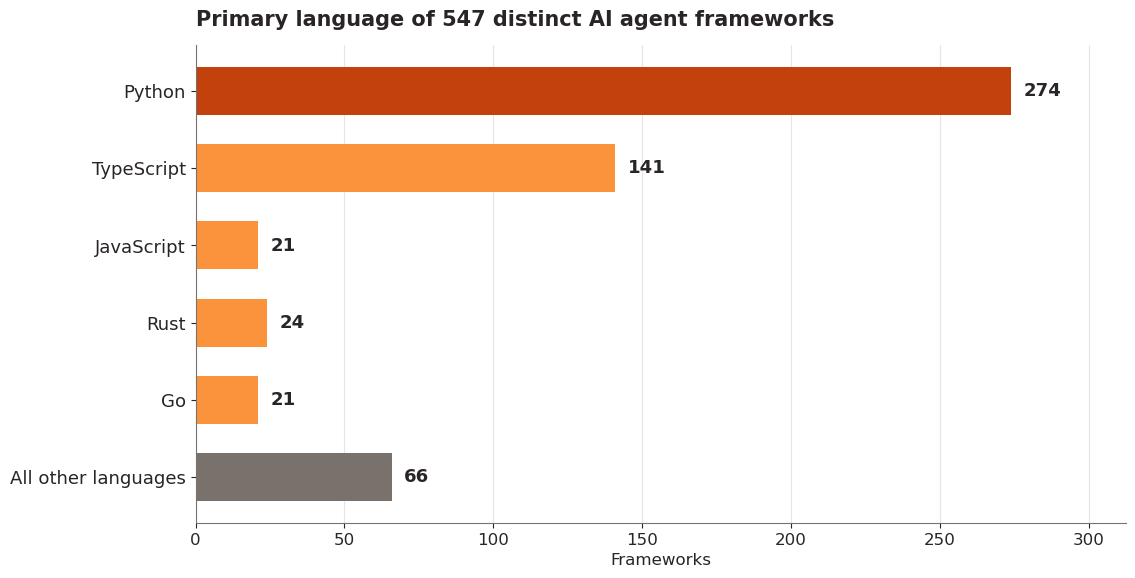
Why the language split settles the phone question
TypeScript and JavaScript frameworks are the ones a phone can genuinely wrap. They already run in browsers and webviews, so a builder app on either platform is usually a polished window onto a stack that feels native to the web. Python frameworks are the opposite case: half the field lives on servers and desktops, and a phone app for a Python framework is a remote control, not a runtime. It can start runs, approve steps, and show results. It cannot host the agent.
That is why the platform debate keeps disappointing people. iOS and Android both wrap the JavaScript family well, both remote-control Python equally well, and neither changes the split. Pick the stack first. The app follows.
The iOS options, honestly

On iOS, the ChatGPT app with custom GPTs is the simplest agent-ish builder, no code required. Apple Shortcuts combined with API calls can trigger agents you built elsewhere. Voiceflow and Botpress both run fine in mobile Safari for light editing. The Zapier iOS app handles monitoring and approvals on the go. None of these turns the phone into a build machine, and that is fine: they cover the trigger, edit, and approve moments, which are the moments that actually happen away from a desk.
The Android options, honestly
On Android, the same web apps work in Chrome, and Android's more open system lets you run local helpers via Termux if you are adventurous. The ChatGPT Android app matches iOS feature for feature. The n8n web UI is usable on a tablet for checking workflow runs. Android's one real edge is that openness: a determined user can keep small utilities alive on the device itself. It still does not move the Python half of the field onto the phone.
The long tail, and why licenses ride along
Beyond the big five, the tail is thin: 13 frameworks are recorded as Jupyter Notebook projects, 8 as Java, and 14 carry no primary language at all, a small reminder that parts of this field are still prototypes in a notebook. Rust at 24 and Go at 21 matter out of proportion to their counts, because both compile to the kind of single binary that ships well inside desktop companions and edge deployments, even if phones still meet them through a server.
One more filter rides along with the platform choice: distribution. MIT covers 255 of the 547 frameworks and Apache 2.0 another 165, so most stacks can be bundled into a commercial companion app without a license fight. The 56 frameworks recorded under other licenses, and the 34 with none recorded, are the ones to read carefully before anything ships to a store. Platform, language, license: in that order, and the phone question answers itself.
Pick the stack first, then the app
The shortlist version of this argument: if you want to build from a phone, stay in the JavaScript family and shortlist with FrameworkPicker, which filters the same 547 frameworks by language, job, license, and momentum. If your framework is Python, budget for a server and treat the phone as the console. The original bottom line of this page still holds: nobody architects a multi-agent system on a phone, and everyone checks on one from a phone. And if you need a companion mobile app that watches your agents and pings you, that is a custom build, exactly the kind of thing PrivateLLM deploy ships alongside the agent itself.